A licence for export, issued before the export route existed
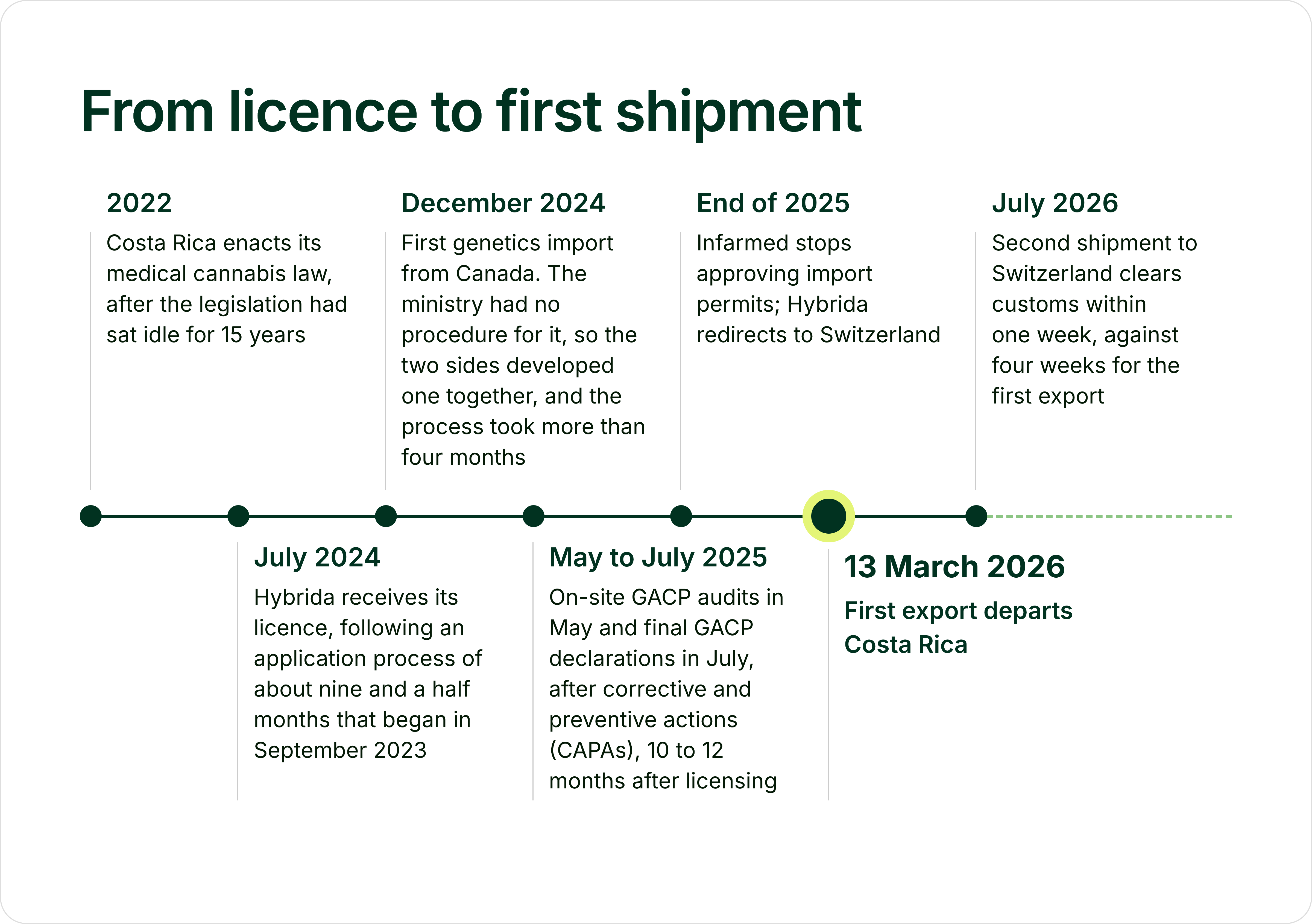
Hybrida’s licence initially permitted export only. That was not a limit within the licence itself: Costa Rica had no regulatory framework for local sales, and that framework is now in place and under further review. Alongside securing the licence, Hybrida had to run three tasks in parallel: preparing the compliance documentation, converting a former agricultural site into a facility, and securing genetics from abroad. The export route also depended on bodies outside Costa Rica: Canada for genetics, Switzerland as the destination, and the INCB for international narcotics reporting. It took about a year after licensing to reach a first cultivation cycle.
Genetics import took the longest. Costa Rica’s seed law made no provision for cannabis genetics, so the first import, in December 2024, required a procedure that had never been run before and that Hybrida helped the ministry establish. The process took more than four months and is now routine. A further genetics import application, opened on 18 November 2024, was still not finalised 696 days later, on 15 October 2026. In the meantime, Hybrida requested a roundtable with the Ministry of Agriculture and the Presidential House, and took part in the group that consolidated the resulting changes to the law and a new regulation. Any licensed Costa Rican operator can now import cannabis genetics through that routine procedure. More recently, Hybrida and the Costa Rican Medicinal Cannabis Chamber (CCCM) requested a national technical committee on cannabis, promoted by the Legislative Assembly. It is now discussing reform of the decrees that regulate medicinal cannabis (44917-S and 44695-MAG-S).
Two on-site audits passed within 10 to 12 months of licensing.
Cannavigia representatives were in Costa Rica shortly after the licence was granted, working through the GACP and GMP framework with Hybrida’s team. The results:
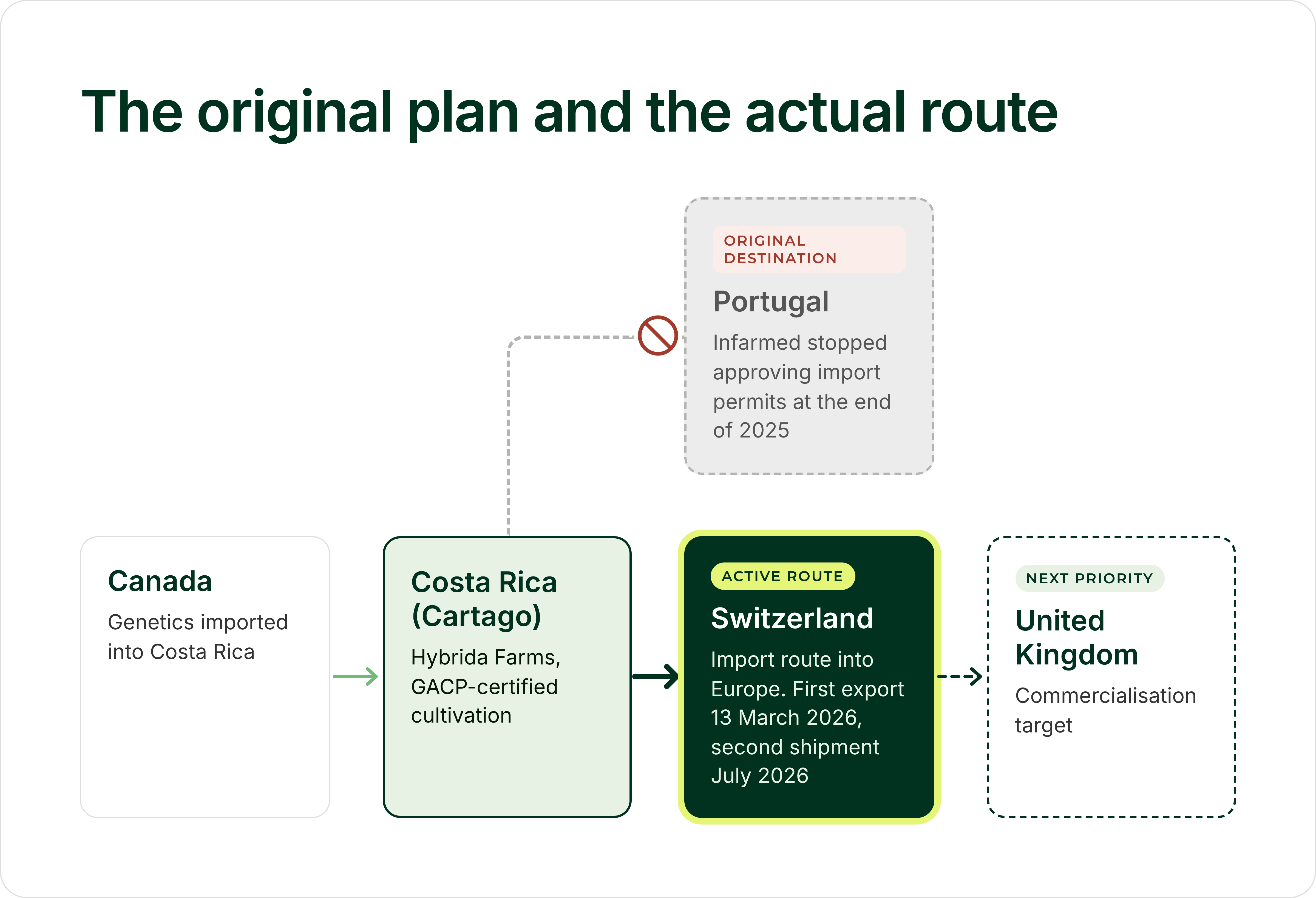
At the end of 2025, when Hybrida was ready to export, Portugal was the most commonly used destination, with the necessary services in place, and the plan ran through Portuguese GMP processors. At that point, Infarmed stopped approving import permits across the market. The application Cannavigia had submitted for Hybrida was held up along with the rest, and Hybrida has still not received a Portuguese permit despite further attempts.
“Portugal closed all import permit approvals. So we had all of our eggs in the Portugal basket through various GMP processors, and we couldn’t get an import permit.” Riley Shields, Director of Production, Hybrida Farms
Cannavigia made introductions across the Swiss and German markets, and Hybrida established its import route into Switzerland. Hybrida reports that Swiss regulators were communicative and that permitting for imports from new countries moved faster than elsewhere. Switzerland also keeps onward destinations open. Hybrida is now prioritising the United Kingdom, which it sees as a more direct route than Germany, where operators describe regulatory changes arriving almost daily.
A new reporting route in Costa Rica and a customs document gap, both resolved within weeks
Two documentation steps set the pace of the first export, and neither involved the product:
The document set for the Costa Rica–Switzerland route now covers phytosanitary certificates, the Swissmedic import permit, the Ministry of Health export permit, declarations on the treatment and handling of the material, and INCB reporting.
A hand-signed export step still runs alongside the digital pathway. Hybrida has proposed moving it into the digital system and has received encouraging feedback from the authorities.
“First to second, much smoother process. And hopefully second to third and third to fourth, we even get smoother there.” Riley Shields, Director of Production, Hybrida Farms
“We have encountered resistance from some sectors that are less receptive to new ideas, but we have also built a support network that benefits the entire country. This model took shape with the establishment of the Medicinal Cannabis Technical Table (Mesa Técnica de Cannabis Medicinal), promoted by the Legislative Assembly at the request of our company and the Costa Rican Medicinal Cannabis Chamber (CCCM).” Jorge Luis Calderón Chaves, President, Hybrida Farms
For cultivators in Latin America, Africa and other emerging cannabis-export markets, Hybrida’s timeline is a reference point: roughly 20 months from licence to first shipment, in a country that had no framework for domestic sales and where regulation is still in development. Riley credits the production, maintenance and administrative staff who held to the timeline through every change of plan.

Getting the licence is step one of eight. The full path includes documentation, pre-approval compliance checks, security and traceability plans, and sanitary registration before a single product reaches a pharmacy shelf.
Staying compliant afterward means six years of audit-ready records, GACP and GMP standards, and export documentation if international markets are the goal.
We've mapped the complete process, every step, every fee, every document the Ministry of Health and MAG require, in a free guide.