Smart Monitoring in EU Cannabis: Preventing Equipment Failures in Cannabis Cultivation
In EU cannabis cultivation, a broken chiller or failing dehumidifier is never “just” a technical problem. It can trigger environmental deviations, batch investigations, and uncomfortable questions during EU‑GMP or EU‑GACP inspections. Smart monitoring with sensors and predictive maintenance helps operators move away from firefighting and towards controlled, well‑documented environments that regulators and partners can trust.
Instead of relying on walk‑throughs and spreadsheets, EU facilities are beginning to treat environmental and equipment data as critical infrastructure: something that protects harvests, simplifies audits, and supports licence renewals.
Where Equipment Failures Hurt Most
Three areas tend to cause the biggest pain in EU facilities:
- HVAC and dehumidification
A drift in temperature or humidity during flowering or drying can affect potency, terpene profile, mould risk, and batch‑to‑batch consistency. Under EU‑GMP expectations for suitable premises and equipment, unexplained environmental swings are difficult to defend.
- Irrigation and fertigation
Pump failures, clogged lines or faulty valves can stress plants and create uneven growth. That shows up later as yield loss and variability between rooms or batches, exactly what medical buyers and pharmacists want to avoid.
- Lighting
LEDs rarely fail overnight; they slowly lose output or shift spectrum. If that no longer matches your validated cultivation setup, you get a gap between what was proven in validation and what is happening now in your grow rooms.
Across all three, the pattern is the same: without good monitoring, problems are spotted late, documented poorly, and hard to explain to auditors.
What Smart Monitoring Actually Looks Like
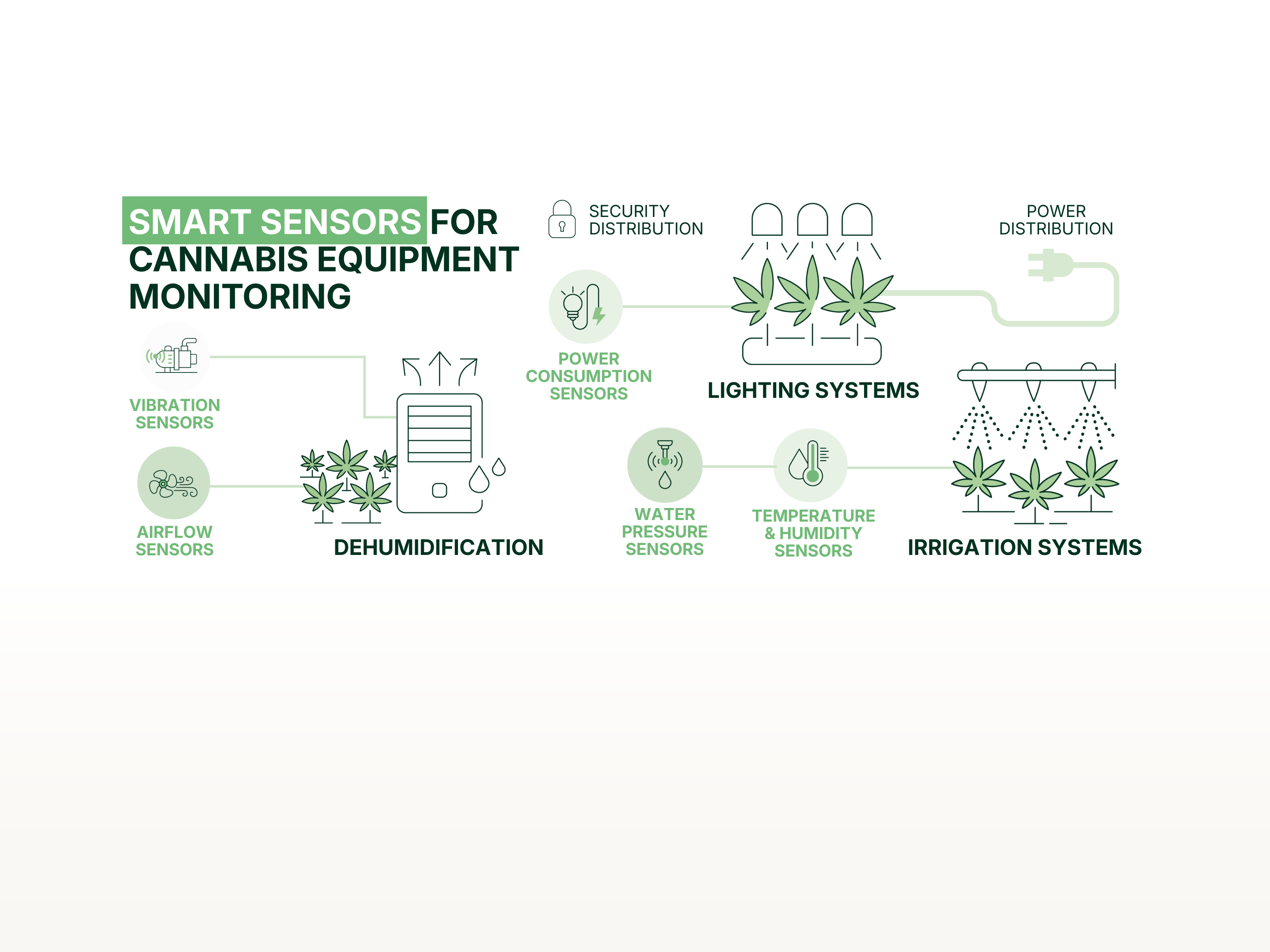
Smart monitoring is more than hanging a few loggers on the wall. A practical EU‑ready setup usually combines:
- Multiple sensor types
- Vibration sensors on fans, pumps and compressors to catch mechanical wear early.
- Power‑draw monitoring on HVAC, dehumidifiers, irrigation and lights to flag abnormal load.
- Temperature, humidity, CO₂ and pressure sensors in all critical rooms.
- Flow and pressure sensors on irrigation lines.
- Local processing and clear alerts
Data is processed on‑site so alerts still fire even if the internet drops. Thresholds are linked to validated ranges and SOPs, not just grower preference.
- Simple alert hierarchy
- Critical: room out of spec, pump down, major fault – act now and open a deviation.
- Warning: performance drifting – schedule maintenance before it becomes a deviation.
- Maintenance: service due based on hours run or cycles completed.
This gives growers and technicians real‑time visibility, while QA gets clean, time‑stamped data that can be dropped straight into batch and deviation records.
How Monitoring Helps with EU‑GMP and EU‑GACP
For EU medical and pharmacy‑bound cannabis, monitoring is as much about documentation as it is about plant health. Good systems:
- Create automatic, audit‑ready records
Continuous logs for temperature, humidity and other critical parameters reduce manual checks and copy‑pasting. Reports export directly into batch files, deviation reports and inspection packs.
- Make investigations faster and more credible
When a test result, complaint or out‑of‑spec event needs investigation, QA can see exactly what the room conditions and equipment status were at that time. Regulators see structured evidence instead of guesswork.
- Strengthen licence and tender positions
Wholesalers, QPs and authorities increasingly ask how you control your environment. Demonstrating robust, validated monitoring and maintenance supports licence renewals, new market entries and supply contracts.
In practice, monitoring turns “we think everything was fine” into “here is the data that shows it.”
A Simple Starting Plan for EU Facilities
You do not need a huge digital‑transformation project to start getting value. A simple approach is:
- Pick your top risks
Choose one high‑value flowering room, your main HVAC/dehumidification unit, and the central irrigation system. These usually have the biggest compliance and yield impact.
- Add sensors and define responses
Install temperature/humidity, power‑draw and (where easy) basic vibration sensors. For each alert type, decide:
- Who is notified.
- How quickly they must respond.
- When QA is informed and when a deviation is opened.
- Connect monitoring to your QMS
Make sure data and alerts link into existing SOPs, deviation/CAPA workflows and batch documentation. Even a small pilot creates value if it is aligned with how your quality system already works.
Once this foundation is stable, you can extend monitoring to more rooms, more equipment and multiple sites, always starting where risk and impact are highest.
Sources