


Costa Rica issued its first medicinal cannabis licences under Law No. 10113 in 2022. By 2026, the country had completed its first medicinal cannabis export to the European Union.
In between those two dates sits a licensing process that has stalled more applicants than it has approved.
Here's what operators need to know before they start.

Medicinal cannabis and industrial hemp (at or below 1% THC) are legal under government licence. Recreational cannabis is not, and remains prosecutable under Law No. 8204, even though small-quantity personal use is generally tolerated in practice.
Two agencies split the licensing work. The Ministry of Health handles psychoactive cannabis derivatives, manufacturing, and sanitary registration. The Ministry of Agriculture and Livestock handles hemp cultivation and agricultural production. Most cultivators of medicinal cannabis need sign-off from both.
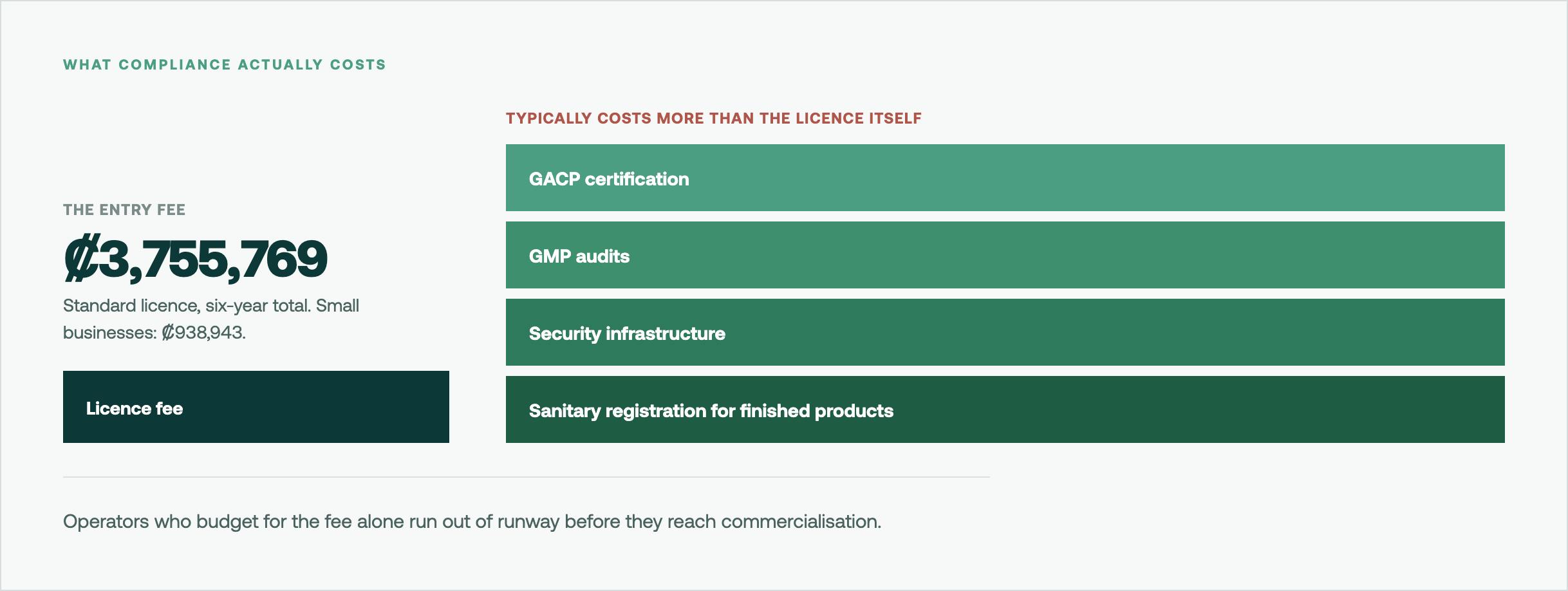
A standard medicinal cannabis licence runs ₡3,755,769.12 over six years, payable annually. Small businesses and small agricultural producer organisations qualify for a reduced rate of ₡938,942.75.
That number is only the entry fee. GACP certification, GMP audits, security infrastructure, and sanitary registration for finished products typically cost more than the licence itself. Operators who budget for the fee alone run out of runway before they reach commercialisation.
Incomplete documentation. Weak security protocols. GMP readiness treated as an afterthought. Facilities that don't match what was submitted on paper.
And missing the payment deadline, the first payment is due within three business days of approval, or the licence is annulled.

Getting the licence is step one of eight. The full path includes documentation, pre-approval compliance checks, security and traceability plans, and sanitary registration before a single product reaches a pharmacy shelf.
Staying compliant afterward means six years of audit-ready records, GACP and GMP standards, and export documentation if international markets are the goal.
We've mapped the complete process, every step, every fee, every document the Ministry of Health and MAG require, in a free guide.
Sources: Law No. 10113 (2022) and its implementing regulations (February 2025); Decreto Ejecutivo No. 43724-MP-S-MAG.


